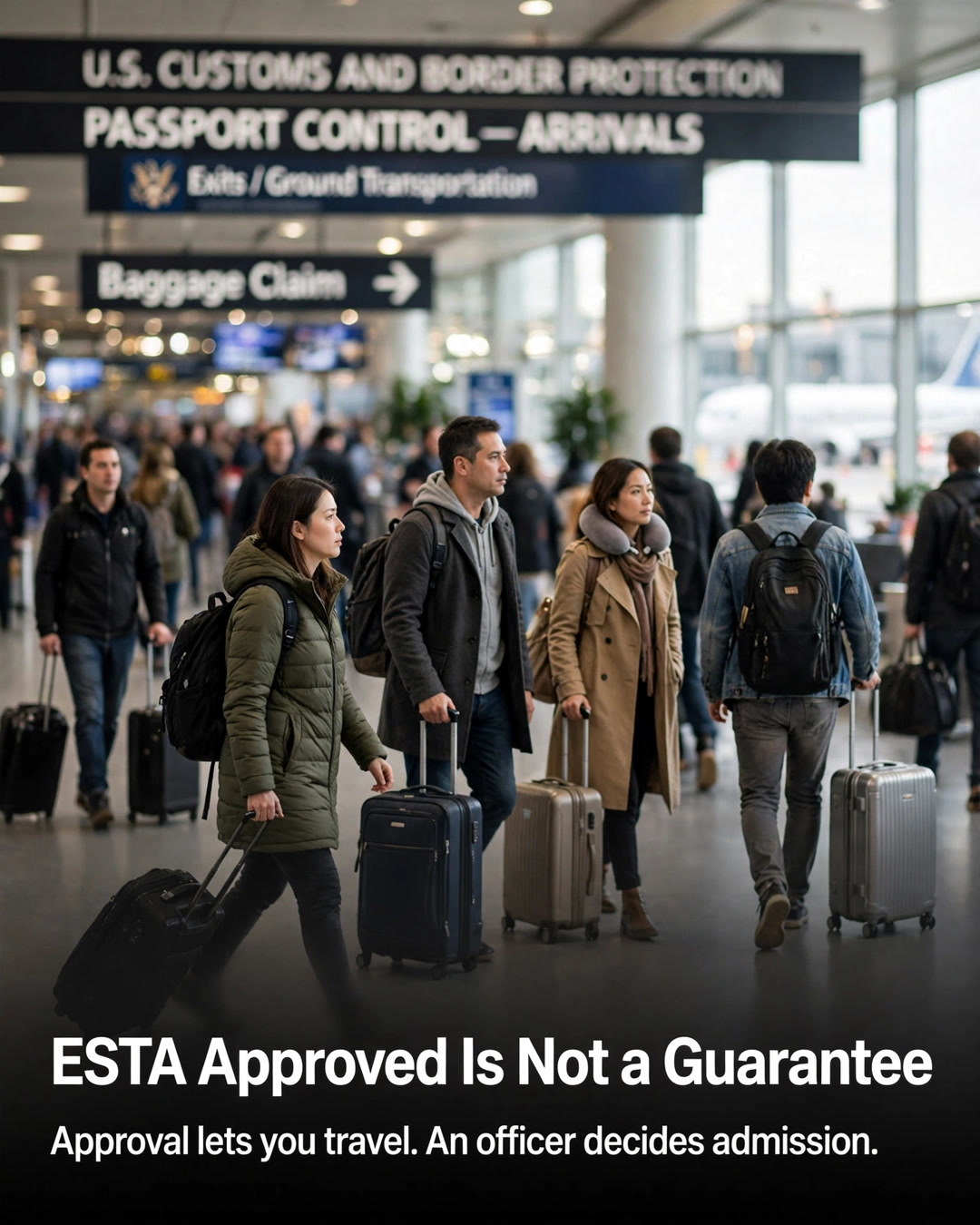
An approved ESTA feels like a green light. It is not. The Electronic System for Travel Authorization does one thing: it authorizes a traveler from a Visa Waiver Program country to board a carrier bound for the United States. Whether that traveler is actually admitted is decided later, in person, by a U.S. Customs and Border Protection officer at the port of entry — and the answer is sometimes no.
The Department of Homeland Security states the distinction in its own words: "A travel authorization does not guarantee admission to the United States as a CBP officer at a port of entry will make the final determination regarding admissibility." The same warning appears on the ESTA application itself. Approval means the pre-travel vetting found no bar to travel under the Visa Waiver Program. Admission is a separate decision, made on the day, on the traveler's documents, answers, and history.
That gap surprises travelers because ESTA feels final — it arrives by email, it lasts two years, and airlines treat it as clearance to board. But the border inspection is where the rules are actually applied, and some of those rules reach back years: a trip to Cuba, an overstay on a previous visit, or an inaccurate answer on the application can end a trip that ESTA approved.
This is what ESTA does and does not do, who can lose eligibility, why travelers are refused at the border, and what to do when ESTA — or the officer — says no.
Information checked: October 28, 2026.
What Is ESTA, and What Does Approval Actually Mean?
ESTA is the online pre-screening system for the Visa Waiver Program (VWP), which lets citizens of 42 countries travel to the United States for tourism or business for up to 90 days without a visa. Before traveling, each VWP traveler must apply through the official ESTA website and receive an approved authorization linked to the passport they will travel with.
Approval means the traveler is authorized to travel to the United States under the VWP. It is not a visa, and it does not determine admissibility. On arrival, every traveler is inspected by a CBP officer, who decides whether the person is admissible under U.S. immigration law — based on documentation, stated purpose of travel, eligibility, and information available at the time of inspection.
An approved ESTA is generally valid for two years, or until the passport it is linked to expires, whichever comes first, and it covers multiple trips. A new authorization is required if the traveler gets a new passport, changes name, gender, or citizenship, or if the circumstances behind any previous application answer change. The authorization can also be revoked at any time if CBP later finds the traveler ineligible.
Who Can Lose ESTA Eligibility?
Some travelers are not eligible for ESTA at all, no matter how straightforward their trip looks. The biggest single cause is travel history. Under the Visa Waiver Program Improvement and Terrorist Travel Prevention Act of 2015 and later DHS policy, nationals of VWP countries who have traveled to or been present in the following countries are not eligible for ESTA and must apply for a visa instead:
Iran, Iraq, Libya, North Korea, Somalia, Sudan, Syria, and Yemen — presence on or after March 1, 2011.
Cuba — presence on or after January 12, 2021, the date Cuba was designated a State Sponsor of Terrorism.
The Cuba rule catches the most travelers by surprise, because it applies regardless of the reason for the visit — tourism, business, journalism, or family — and an ESTA already granted can be revoked if CBP later determines the traveler was in Cuba on or after that date. Dual nationals are affected too: nationals of VWP countries who also hold nationality of Cuba, Iran, Iraq, North Korea, Sudan, or Syria are generally ineligible for ESTA. Narrow exceptions exist for travel performed on official government or military duties for a VWP country, with documentation.
Other common reasons ESTA is denied include a previous overstay or violation of a U.S. visa or VWP stay, unauthorized work during a past visit, a criminal history, inaccurate or incomplete answers on the application, and a previous ESTA or visa refusal. Each case is assessed on its own facts, and a denial is not always permanent — but reapplying without addressing the underlying reason usually produces the same result.
Why Are Travelers Refused at the Border Despite an Approved ESTA?
At the port of entry, the officer's job is different from the ESTA system's job. ESTA checks the traveler's background against databases before travel; the officer checks the traveler in front of them. The officer may ask about the purpose of the trip, how long the traveler intends to stay, return or onward travel plans, finances, employment, family ties, and prior travel — and may refer the traveler to secondary inspection for a longer interview.
Refusal typically follows when the officer finds an inconsistency or a ground of inadmissibility: a stated purpose that does not match the evidence, signs the traveler intends to work or stay beyond the 90-day VWP limit, a prior overstay or violation, a criminal record, or misrepresentation — giving inaccurate, incomplete, or contradictory answers. Under the Immigration and Nationality Act, willful misrepresentation is itself a ground of inadmissibility, which is why inconsistent answers at inspection can be more damaging than the underlying facts.
The decision is made case by case, and it is the officer's to make. Membership in a Trusted Traveler program such as Global Entry does not exempt a traveler from inspection, and a long history of trouble-free entries does not guarantee the next one. Travelers who believe they were wrongly delayed or denied can seek redress through the DHS Traveler Redress Inquiry Program (DHS TRIP).
What Happens If ESTA Says "Travel Not Authorized"?
A "Travel Not Authorized" response means the applicant is not authorized to travel to the United States under the Visa Waiver Program. It does not deny entry into the United States, and it is not a travel ban — it only prohibits travel under the VWP. The traveler may still be able to obtain a visa from the U.S. Department of State for travel.
The practical route is a B-1/B-2 visitor visa, applied for at a U.S. embassy or consulate. That process is longer and more involved than ESTA: a form, a fee, and usually an in-person interview, with processing times that can run to weeks or months. Travelers who may need a visa should therefore apply as soon as travel plans begin, not after booking a flight — and anyone with Cuba travel, a prior overstay, or a criminal record should assume a visa will be needed and start early.
There is no appeal against an ESTA denial as such, and CBP will not explain the specific reason for a denial through its customer service channels; questions about a specific application go to the DHS redress process. A fresh ESTA application with the same facts will almost always produce the same answer. If circumstances have genuinely changed — a new passport, a corrected error, a changed answer — a new application may be appropriate, but travelers should verify the current guidance on the official ESTA site first.
What Should You Check Before You Travel?
ESTA problems are cheapest to fix before departure. Before any trip under the Visa Waiver Program, run through this checklist:
Apply only through the official ESTA website (esta.cbp.dhs.gov) or the official ESTA mobile app. Third-party sites are not endorsed by DHS, may charge extra, and cannot speed up a decision.
Apply as soon as travel plans begin. Most decisions arrive quickly, but some applications take up to 72 hours, and a denial leaves only the visa route — which takes far longer.
Check the ESTA status for the exact passport you will travel with. A new passport needs a new ESTA, and the name on the ticket must match the passport.
Review the eligibility questions honestly, including travel history. Presence in Cuba on or after January 12, 2021, or in the other listed countries since March 1, 2011, means a visa is needed instead.
Carry evidence of the trip's temporary purpose: a return or onward ticket, accommodation details, and proof of ties to home such as employment or enrollment. Be ready to explain the trip clearly and consistently at inspection.
If ESTA is denied, do not reapply with the same facts and do not book non-refundable travel. Start a B visa application at the nearest U.S. embassy or consulate.
An approved ESTA is the start of the journey, not the end of the process. The admission decision is made at the border, by an officer, on the day — and travelers who understand that distinction are the ones least likely to be surprised by it.
Official Sources
U.S. Customs and Border Protection — Frequently Asked Questions about the Visa Waiver Program (VWP) and the Electronic System for Travel Authorization (ESTA)
U.S. Customs and Border Protection — Official ESTA Application Website
U.S. Department of Homeland Security — Privacy Impact Assessment: ESTA (DHS/CBP/PIA-007(h))
https://www.dhs.gov/sites/default/files/2023-06/privacy-pia-cbp007(h)-esta-june2023.pdf
NNU Immigration — Can I get an ESTA if I've been to Cuba?
https://www.nnuimmigration.com/can-i-get-an-esta-if-i-have-been-to-cuba/
This article reflects ESTA and Visa Waiver Program rules available on October 28, 2026. Eligibility rules, country lists, and fees can change — confirm the current rules on the official ESTA and CBP websites before you travel.