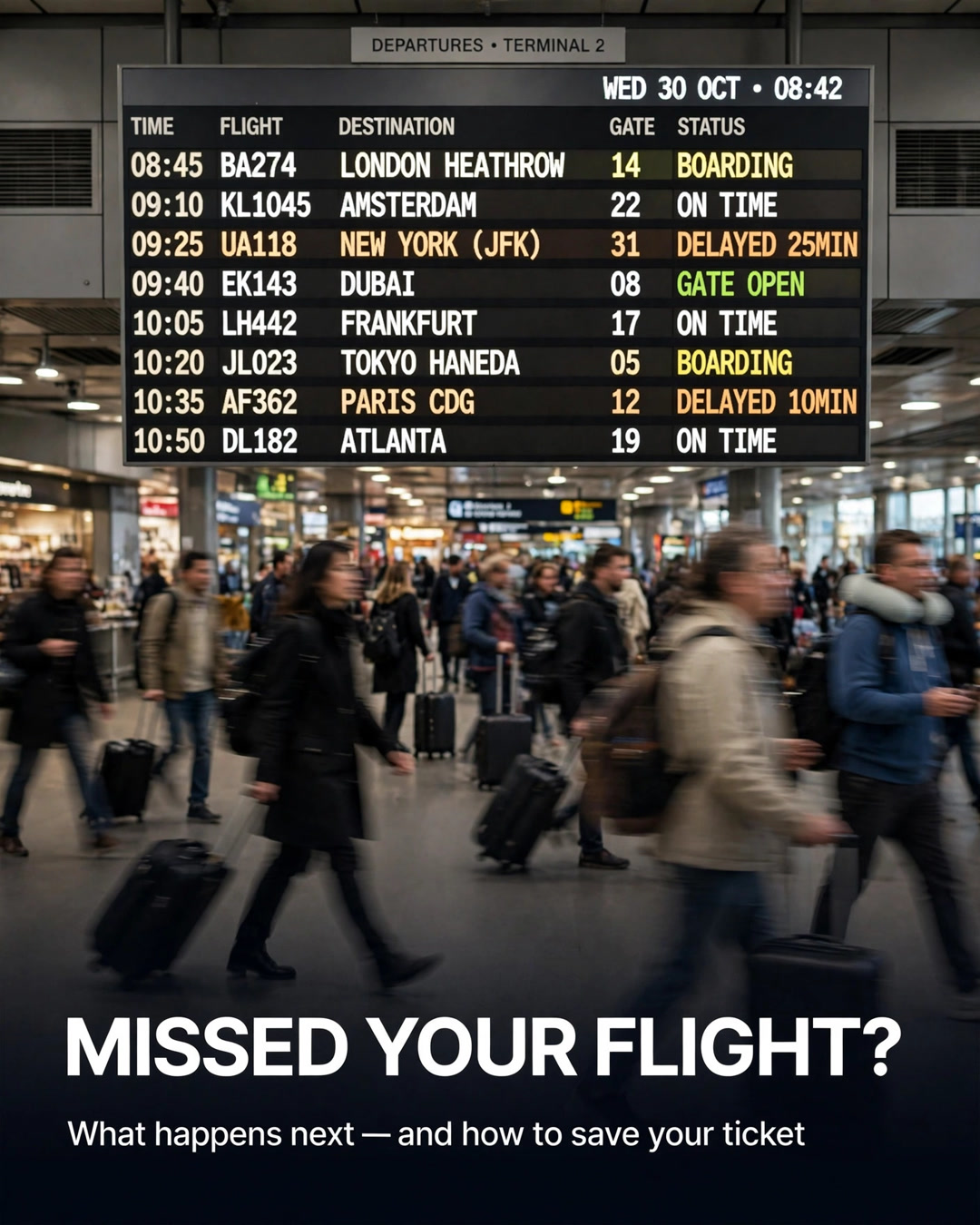
Missing a flight is stressful enough. What surprises most travelers is what happens next: on a typical round-trip ticket, failing to board one flight can cancel the rest of your itinerary — including your return home — and a non-refundable ticket can lose its remaining value entirely. The airline's system reads a missed segment as an abandoned trip, and it acts on that reading automatically.
That outcome is not inevitable. The difference between losing a ticket and keeping its value usually comes down to one thing: whether you contacted the airline before the flight departed. Calling or changing your booking before takeoff turns a no-show into a voluntary change, and on most U.S. carriers that keeps the fare alive as credit. Doing nothing is the one move that costs the most.
The rules behind this sit in each airline's contract of carriage and fare rules, and they differ by carrier, fare class, and route. Basic economy fares are far stricter than main-cabin fares, and the best-known escape route — the so-called "flat tire rule" — is an unpublished courtesy, not a passenger right. This is what a no-show means, what it does to the rest of your booking, what happens to the money you paid, and the exact steps to take when you know you will miss a flight.
Information checked: October 28, 2026.
What Does "No-Show" Actually Mean?
A no-show is what the airline records when you neither board your flight nor cancel or change the booking before departure. The moment boarding closes without you, the reservation is flagged, and the unused flight coupons are treated as abandoned. It does not matter that you paid for the ticket: the contract you accepted at booking lets the airline apply its no-show clause.
Checking in does not save you. If you check in but fail to board, you are still recorded as a no-show, and the same cancellation follows. There is one practical difference: if your checked bags were already loaded, they must be located and removed before the aircraft departs — a security rule that can delay the flight — and you will need to claim them from the airline's baggage office.
A no-show is different from a missed connection. If you miss a connecting flight because your first flight on the same booking was delayed or cancelled, that is the airline's responsibility, not a no-show — and different rules apply, covered below.
Is Your Return Flight Cancelled Too?
In most cases, yes. Airlines sell round-trip and multi-segment itineraries as a sequence of flight coupons that must be used in order. When one segment is marked as a no-show, the system assumes the trip has been abandoned and automatically cancels every remaining segment on that booking — connections and the return flight included.
This is the costliest misunderstanding in air travel. Many travelers assume they can skip the outbound flight and simply board the return. On a single round-trip booking with a major carrier, that return seat is usually gone by the time they arrive at the airport, and getting it back means buying a new ticket, often at a last-minute fare.
There are two exceptions worth knowing:
Separate bookings are independent. If your outbound and return flights were booked as separate one-way tickets, missing one does not affect the other — even on the same airline.
Some low-cost carriers treat each flight as a standalone segment, so a missed outbound may leave the return intact. This varies by carrier and is not the norm among full-service airlines — check before you rely on it.
If you think you may miss a flight, tell the airline before departure. That single contact is what keeps the rest of the booking alive while you rebook.
Do You Lose the Value of Your Ticket?
It depends on your fare — and on whether you contacted the airline before departure.
If you cancel or change before departure, the value of a non-refundable ticket usually survives as credit toward a future flight. The major U.S. carriers eliminated change fees for most main-cabin and higher fares on tickets originating in the United States, Canada, and the Caribbean in 2020, so a voluntary change typically costs only any fare difference if the new flight is more expensive. Refundable fares can be refunded under their fare rules, provided the cancellation happens before departure.
If you simply do not show up, the picture is much harsher. On non-refundable tickets, Delta, United, and American treat a no-show as forfeiting the ticket's remaining value, and the rest of the itinerary is cancelled with it. Even refundable tickets can lose out if no cancellation is made before departure — the refund depends on the fare rules being followed.
Basic economy is the strictest case of all. These fares are generally non-changeable, and the reservation must be cancelled before departure or the full value of the ticket is forfeited. Some basic economy fares allow cancellation for a partial credit minus a cancellation charge — as of October 2026, published summaries put those charges at roughly $99 to $199 on Delta's Main Basic fares and $49.50 to $99 on United's Basic Economy domestic fares, varying by route and market — but if the charge exceeds the fare, nothing is left. If there is any chance your plans could change, a main-cabin fare is the safer buy.
What Is the "Flat Tire Rule"?
The "flat tire rule" is the travel world's best-known unwritten policy. It is the informal practice, most common among U.S. carriers, of rebooking a passenger who arrives at the airport shortly after their flight departed — typically within about two hours — onto the next available flight on standby, usually at no charge.
It is a courtesy, not a right. It appears in no contract of carriage, and agents apply it at their discretion. Reports of how it works differ by airline: American Airlines representatives have described rebooking within two hours of departure on standby without change fees or fare differences, and Southwest has a similar two-hour practice; Delta assesses these cases individually and decides at the airport; United's window is reported as shorter. Budget carriers such as Spirit and Frontier rarely offer it at all — on those airlines, a missed flight usually means buying a new ticket.
Three things make it more likely to work in your favor: show up in person rather than calling, be brief and polite about what happened, and ask specifically for standby on the next departure. It is discretionary goodwill, and it works best when the agent has a seat to give and a calm traveler to give it to.
What Should You Do Step by Step?
The order matters. Minutes count, because every option narrows once the flight departs.
The moment you know you will miss it, call the airline or use its app to change or cancel — before the scheduled departure time. This is the step that preserves your ticket's value.
If you are already at the airport, go straight to the airline's service desk or a gate agent. Do not join a long general line if the phone or app can reach an agent faster — seats on the next flight go first to the people who ask first.
Ask for standby on the next departure to your destination, and ask whether a confirmed change is available and what it costs. Standby is free on many fares; a confirmed seat may involve a fare difference.
If you checked bags and did not board, tell an agent where your bags are so they can be tracked and returned to you.
Keep your boarding passes, booking confirmations, and any evidence of the delay — a traffic report, a breakdown receipt, or a screenshot of a delayed inbound flight. They help if you later claim on travel insurance or a credit card's trip protection.
If the airline will not rebook you, ask what the ticket is worth as credit and how long the credit lasts, rather than walking away. Credits typically expire about a year from the original ticket date.
Do not buy a new ticket before you have spoken to the airline. A new booking does not restore the old one, and you may end up paying twice for the same trip.
What If the Airline Caused You to Miss Your Flight?
When the airline is at fault, the rules flip in your favor. If you miss a connection because your first flight on the same booking was delayed or cancelled, the airline must rebook you on the next available flight at no extra charge. This is an involuntary misconnection, not a no-show, and your return flights stay intact.
If the airline cancels your flight or makes a significant schedule change and you choose not to travel on the rebooking offered, U.S. Department of Transportation rules entitle you to a cash refund of the unused portion of the ticket — not only a voucher. That refund right applies to airline-cancelled and significantly changed flights, not to flights you voluntarily missed.
Travel insurance or credit card trip protection can cover the gap in other cases. If you missed the flight for a covered reason — illness, an accident, or severe documented disruption — a policy or card benefit may reimburse what the airline will not. Check the coverage terms before you assume you are covered, and keep the documentation the claim will ask for.
Before you fly, run through this checklist:
Know your fare: basic economy means cancel before departure or lose the value.
Save the airline's phone number and app login in your phone before you travel.
If you will miss the flight, contact the airline before departure — that call is what keeps the ticket alive.
At the airport within about two hours? Ask for standby under the flat tire rule, politely and in person.
Keep every boarding pass and delay notice until the trip is over.
Confirm the fare rules for your exact ticket — no two airlines apply these policies identically.
A missed flight does not have to mean a lost trip. The ticket's value survives when the airline hears from you before departure — and it is the silence, not the delay, that costs the most.
Official Sources
Elliott Report — Travel companies say you're a no-show. But are you?
https://www.elliott.org/on-travel/travel-companies-say-their-customers-are-no-shows-but-are-they/
Alternative Airlines — What Happens If You Miss Your Flight?
https://www.alternativeairlines.com/missed-flight-what-to-do
Delta Air Lines — Basic Economy fare rules (Delta Professional)
WithAutopilot — Basic Economy Change & Cancel Rules by Airline (2026)
https://withautopilot.com/blog/basic-economy-change-cancel-rules
Flights Cheap Fare — Can I Get a Refund If I Miss My Flight? What Airlines Actually Do
https://www.flightscheapfare.com/blog/missed-flight-refund.html
This article reflects airline no-show and rebooking policies available on October 28, 2026. The flat tire rule is an unpublished courtesy that varies by airline and agent, and fare rules change — confirm the rules for your exact ticket with your airline before you travel.