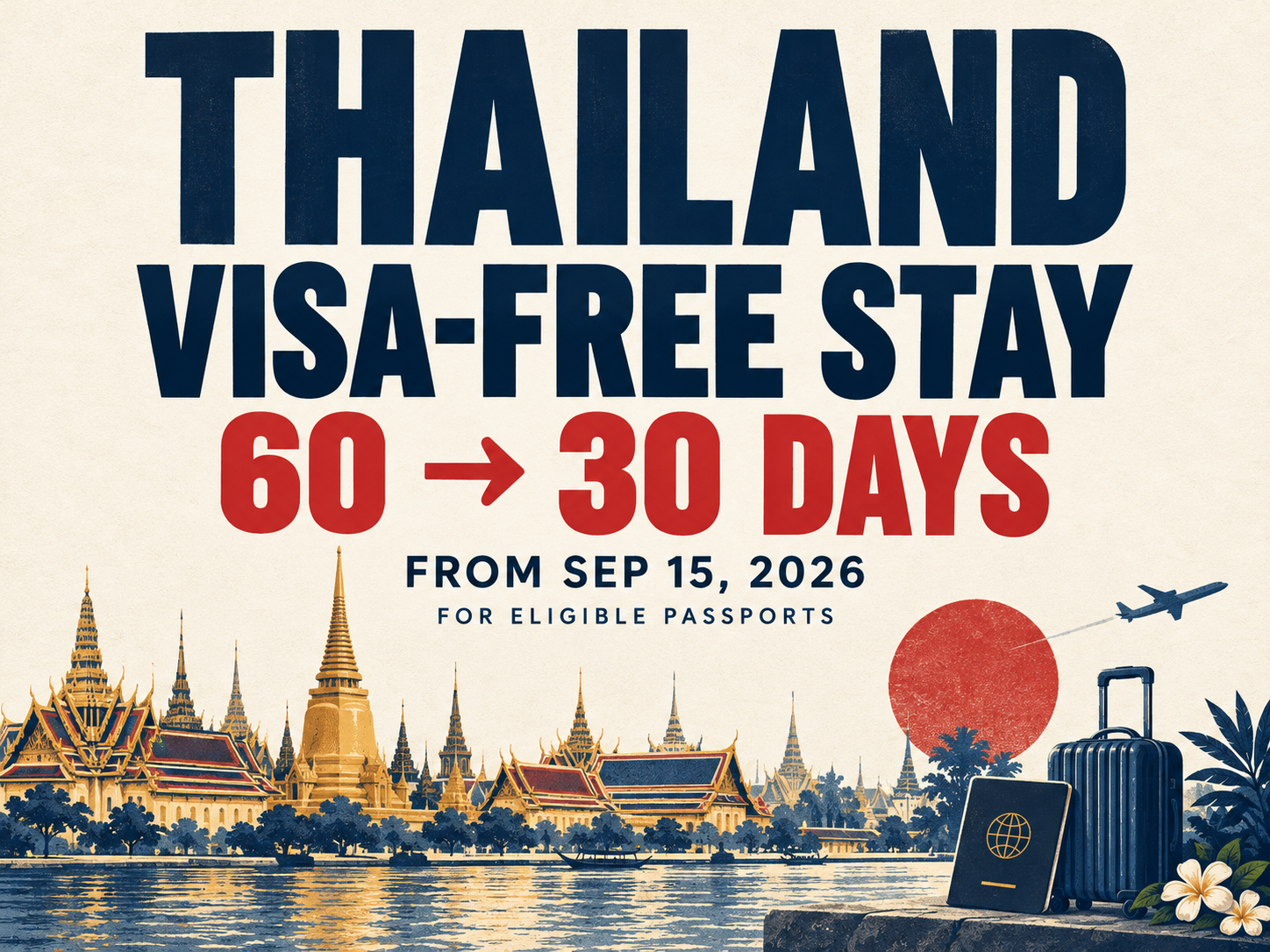
Thailand ended its previous 60-day visa-exemption scheme on September 15, 2026.
Under the revised rules, passport holders from 60 countries and territories—including the United States, Canada, the United Kingdom, and Australia—can visit Thailand for tourism without a visa for up to 30 days.
However, the new limit does not apply to every traveler. Separate bilateral agreements continue to allow different stay periods for certain nationalities.
If you are planning an extended holiday or a multi-country trip through Southeast Asia, check the rules for your passport before booking.
Information checked: October 27, 2026.

────────────────────
What Changed on September 15, 2026?
Thailand’s revised entry measures were published in the Royal Gazette on August 31, 2026, and took effect on September 15.
The changes include:
• Ending the previous 60-day visa-exemption scheme.
• Providing a 30-day tourism exemption for 60 countries and territories.
• Introducing a 15-day exemption for Seychelles and Mauritius.
• Limiting Visa on Arrival eligibility to Azerbaijan, Belarus, and Serbia.
Separate bilateral visa-exemption agreements remain relevant.
This means that older advice saying visitors from 93 countries can automatically stay for 60 days is no longer a reliable basis for planning a new trip.
────────────────────
Who Qualifies for the 30-Day Visa Exemption?

The revised 30-day tourism exemption includes passport holders from:
• United States
• Canada
• United Kingdom
• Australia
• New Zealand
• Japan
• India
• Singapore
• Malaysia
• Many European countries
These are examples, not the complete list.
Eligibility depends on your passport and the applicable entry arrangement. Living in an eligible country does not automatically give you the same privileges as its citizens.
For example, a U.S. permanent resident traveling on another country’s passport must check the rules for that passport. A green card does not turn it into a U.S. passport for Thai entry purposes.
Check every traveler separately when family members hold different nationalities.
────────────────────
Why Some Travelers Can Still Stay Longer
The end of the general 60-day scheme does not cancel all of Thailand’s bilateral visa-exemption agreements.
Official embassy guidance lists Argentina, Brazil, Chile, Peru, and South Korea among the countries whose ordinary-passport holders may qualify for visits of up to 90 days under bilateral agreements.
Other agreements provide stays of up to 30 or 14 days.
There is therefore no single visa-free stay period that applies to every foreign visitor.
Check your nationality, passport type, purpose of travel, and applicable agreement. Immigration authorities determine admission and the authorized period of stay when you arrive.
────────────────────
What Happens If You Entered Before September 15?
Travelers admitted before September 15, 2026, do not automatically lose the stay period they were already granted.
Thailand’s official announcement states that those admitted under the previous arrangements may remain until the end of their authorized stay.
Check the permitted departure date in your passport stamp or immigration record rather than recalculating it from a general travel article.
If the recorded date appears incorrect, contact Thai Immigration promptly.
────────────────────
Can You Extend Your Stay Beyond 30 Days?

The Royal Thai Embassy in Washington, D.C., states that travelers admitted under the revised 30-day tourism exemption may apply for an extension of up to another 30 days.
Approval is at the immigration officer’s discretion.
A possible extension is not the same as a guaranteed 60-day stay. If your itinerary depends on staying longer than your initial permission allows, check suitable visa options before traveling.
Land-border trips require particular care.
Under the revised 30-day exemption, entries through land-border immigration checkpoints are generally limited to twice per calendar year, with specified nationality exceptions.
Do not assume that leaving Thailand briefly guarantees another admission or a fresh stay period.
────────────────────
You May Still Need a Thailand Digital Arrival Card
Visa-free entry and the Thailand Digital Arrival Card are separate requirements.
The TDAC was introduced on May 1, 2025. It was not introduced by the September 2026 visa-exemption change.
Foreign travelers entering Thailand generally need to complete the TDAC before arrival. The Tourism Authority of Thailand advises registering within three days before arrival.
Official portal:
https://tdac.immigration.go.th/
Submitting the TDAC through the official system is free.
The arrival card does not grant a visa, guarantee admission, or extend your permitted stay.
Before departure, check:
• The entry arrangement for your passport.
• Your intended length and purpose of stay.
• Whether your itinerary includes land-border crossings.
• Your TDAC requirements.
• The documents required by your airline and Thai authorities.
The key change is the end of Thailand’s general 60-day visa exemption. For many visitors, the replacement allowance is 30 days—but your passport and any applicable bilateral agreement determine which rules you should follow.
────────────────────
Official Sources
Thai Government Public Relations Department — Revision of Thailand’s Visa Exemption and Visa on Arrival Schemes
https://thailand.prd.go.th/en/content/category/detail/id/48/iid/538547
Royal Thai Embassy, Vienna — Tourist Visa Exemption and Bilateral Agreements
Royal Thai Embassy, Washington, D.C. — Visa Exemption and Visa on Arrival
https://washingtondc.thaiembassy.org/en/page/visaexempt-voajul2024
Tourism Authority of Thailand — Thailand Digital Arrival Card Guide
https://www.tourismthailand.org/Articles/tdac
Thailand Digital Arrival Card — Official Portal
https://tdac.immigration.go.th/
Entry rules may change. Confirm the requirements for your passport with the relevant Royal Thai Embassy or Thai Immigration before traveling.