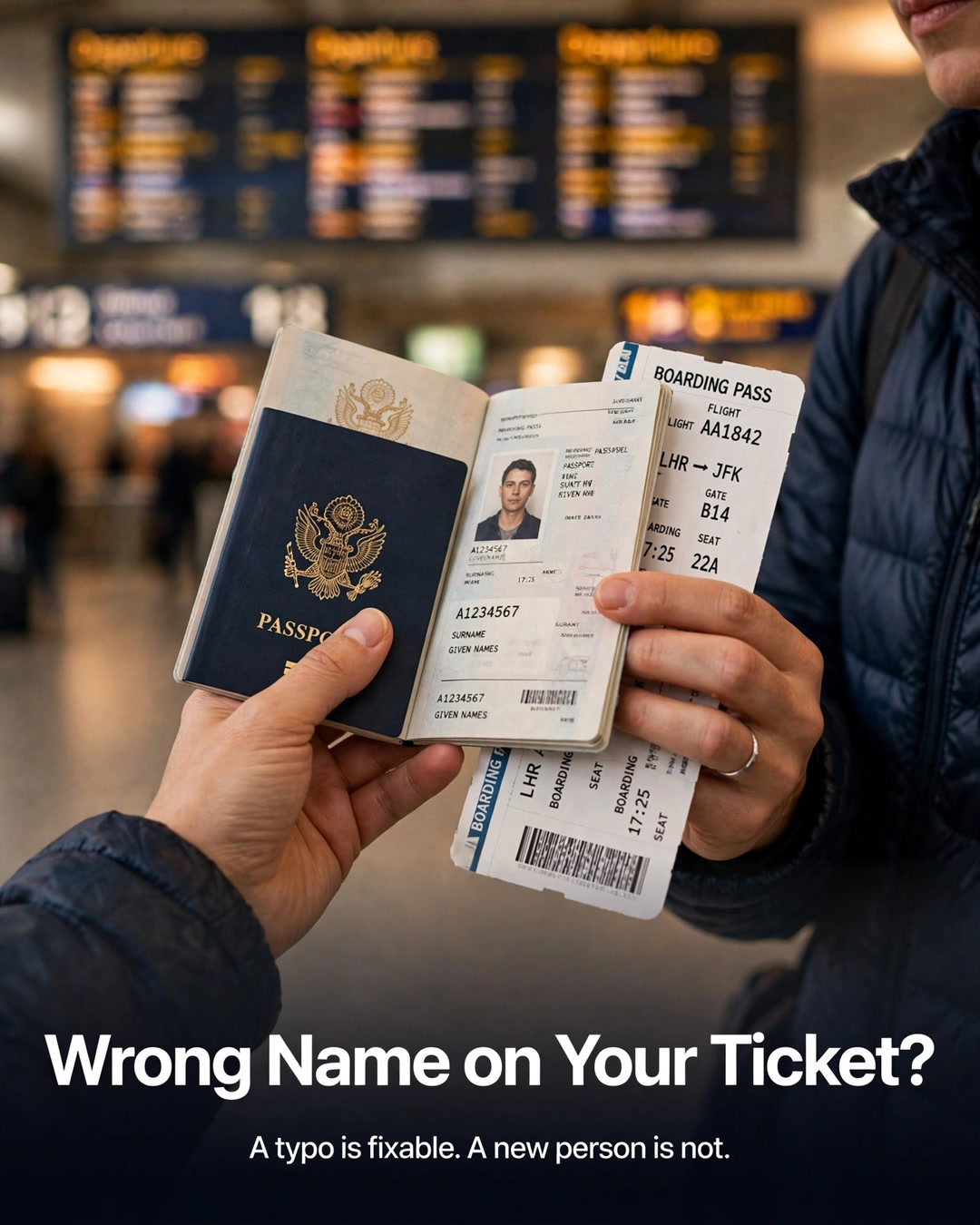
A misspelled name on a flight ticket is one of the easiest travel mistakes to make — and one of the most stressful to discover. The good news is that a small spelling error in your own name is usually fixable. The bad news is that airlines draw a hard line between fixing a typo and changing the traveler, and crossing that line means the ticket cannot be transferred to someone else at all.
The reason the name matters is security, not paperwork. Under the U.S. Transportation Security Administration's Secure Flight program, airlines must send each passenger's name, date of birth, and gender to the TSA before a boarding pass can be issued, and the name submitted must match the name on the government-issued photo ID the passenger will present. A mismatch can mean delays at check-in or at the security checkpoint — and, in the worst case, denied boarding.
What you can fix, what it costs, and how fast you must act all depend on the airline, the fare, and the kind of error. The rules below are the general pattern across major airlines, checked against airline and TSA sources on October 28, 2026 — but exact limits and fees vary, so the airline that issued your ticket always has the final word.
This is the difference between a correction and a change, what the TSA requires, the steps to fix a typo, and how to avoid the problem in the first place.
Information checked: October 28, 2026.
Why Does the Name on Your Ticket Matter?
Because the name on your ticket is the name the TSA checks. Under the Secure Flight program, airlines collect each passenger's full name as it appears on their government-issued ID, along with date of birth and gender, and transmit that data to the TSA for watch-list matching before a boarding pass is issued. Delta's guidance to travel agencies puts it plainly: the security name submitted to Secure Flight must match the name on the non-expired government-issued photo ID the passenger will use when traveling, and it must also match the name in the reservation that generates the boarding pass.
For international travel, the ID is your passport, and the ticket name should match the passport's machine-readable name exactly. For domestic U.S. travel, it is the driver's license or other government-issued photo ID you present. In both cases, the check compares the name on the boarding pass with the ID in your hand.
A small mismatch does not always stop you — airlines and the TSA allow for the way reservation systems truncate long names, and a missing middle name alone is usually not a problem, as American Airlines' Secure Flight guidance notes that the ticket's passenger name field needs first and last name only. But a wrongly spelled first or last name is different: it is the part of the name the system matches, and it is the part you should fix.
What Counts as a Spelling Correction?
A correction fixes a small error in the same traveler's name. The typical examples airlines treat as corrections:
One or two letters misspelled — for example, "Smit" instead of "Smith," or transposed letters.
First and last names entered in the wrong order.
A missing or extra middle name or initial, or a missing suffix such as Jr. or III.
A hyphenated or compound surname entered without the hyphen.
Corrections of this kind are generally allowed by major airlines, and minor ones are often free — especially when caught soon after booking. Some airlines publish a character limit for free corrections (for example, up to two or three letters), but there is no industry-wide standard: the exact threshold is set by each airline, and some fares — particularly basic economy — allow fewer changes than others.
A legal name change after booking — marriage, divorce, or a court order — sits in a middle category. It is the same traveler with a new legal name, so airlines generally allow it, but they usually ask for supporting documents: a marriage certificate, divorce decree, or court order, plus an updated government ID. A reissued ticket may also trigger a fare difference if prices have risen since the original booking.
What Counts as a Name Change — and Why Is It Not Allowed?
A name change, in airline terms, means the ticket would travel under a different person. That is not a correction, and it is not allowed: airline tickets are non-transferable. You cannot give your ticket to a friend, a family member, or a colleague by changing the name on it, no matter how early you ask.
If the name on the ticket belongs to the wrong person entirely — the booking was made for someone else by mistake — the only route is to cancel that booking (subject to the fare's refund rules) and buy a new ticket in the correct traveler's name. Some airlines will process the cancellation and rebooking together, but the old ticket cannot simply be renamed.
This is also why agents and help pages stress the wording of the request. Saying "name correction" routes your call to the typo-fix process; saying "name change" can route it to the fare-change or rebooking queue, where the answer and the price are different. The distinction is the first thing to get right.
How Do You Fix a Misspelled Name?
Fix it as soon as you spot it, and fix it with whoever issued the ticket. The steps:
Find the error. Compare the confirmation email, letter by letter, with the passport or ID you will travel with — first name, last name, and the order they are in.
Call the airline if you booked directly, or the travel agency or booking site if you booked through one. Name corrections are usually handled by phone, because most self-service tools cannot change passenger identity details.
Say "name correction," not "name change." State the name as it currently appears on the ticket and spell out the correct name, letter by letter.
Ask the agent to read the correction back before it is submitted, and confirm any fee before you authorize it.
Get an updated confirmation email before you end the call, and open it immediately to check every character against your ID.
If you booked through a third party, start there: the agency owns the booking, and the airline may not be able to change it directly. Expect the agency to add its own processing fee on top of any airline charge. For codeshare flights — sold by one airline, operated by another — both carriers may need to be involved, so allow extra time.
What Does It Cost, and Is There a Deadline?
There is no single answer, and that is the honest limit of this article. Minor spelling corrections are often free on direct bookings with major U.S. carriers, and many airlines waive the fee when the error is caught within 24 hours of booking. After that window, fees vary widely — published ranges run from around $25 to $200 or more depending on the airline, the fare type, and how close to departure you are — and budget carriers tend to be the least forgiving. Legal name changes may be processed free but can still trigger a fare difference on reissue.
The one deadline that is a rule, not a courtesy, is the U.S. 24-hour rule: for flights to or from the United States booked at least 7 days before departure, airlines must allow a full refund if you cancel within 24 hours of booking. That rule does not require airlines to correct a misspelled name for free — but it gives you a free fallback: cancel the wrong booking and rebook with the correct name. It is the fastest, cheapest fix when you catch the mistake the same day.
There is no universal "must fix by" deadline beyond that, but the practical one is check-in: Secure Flight data is transmitted before departure, usually 72 hours ahead, and a correction made after transmission may need to be resubmitted. Fixing the name days before departure is straightforward; fixing it at the airport is sometimes possible at the ticket counter, but it is the worst place to discover the problem — and on a busy day, it may mean missing the flight.
How Do You Avoid the Problem?
The fix takes minutes; the prevention takes seconds. Before you pay, and again when the confirmation email arrives:
Book with the full legal name exactly as it appears on the passport or ID you will travel with — including hyphenation, and including the middle name if the booking form asks for it.
If you are booking for someone else, get their name from their ID, not from memory.
Watch for autofill: saved browser and booking-site details can insert an old name, a nickname, or a previous surname.
Check the confirmation email the moment it arrives — not the night before the flight. The 24-hour refund window only helps if you catch the error inside it.
If your passport is being renewed or your legal name is changing, book in the name on the document you will actually travel with, and sort out the paperwork before you fly.
A ticket with the wrong name is rarely the end of a trip — but it is always easier to fix from your sofa than from a check-in queue. Check the name before you book, not at the airport.
Official Sources
Delta Air Lines — Secure Flight Passenger Data Program (SFPD)
American Airlines — Secure Flight Passenger Data (SFPD)
https://saleslink.aa.com/en-US/resources/html/sfpd-secure-flight-passenger-data.html
Southwest Airlines — TSA Secure Flight Information
https://support.southwest.com/helpcenter/article/tsa-secure-flight
TSA — Security Screening
https://www.tsa.gov/travel/security-screening
This article reflects airline and TSA guidance available on October 28, 2026. Correction limits, fees, and deadlines vary by airline, fare type, and booking channel — confirm the current rules with the airline or agency that issued your ticket before you travel.