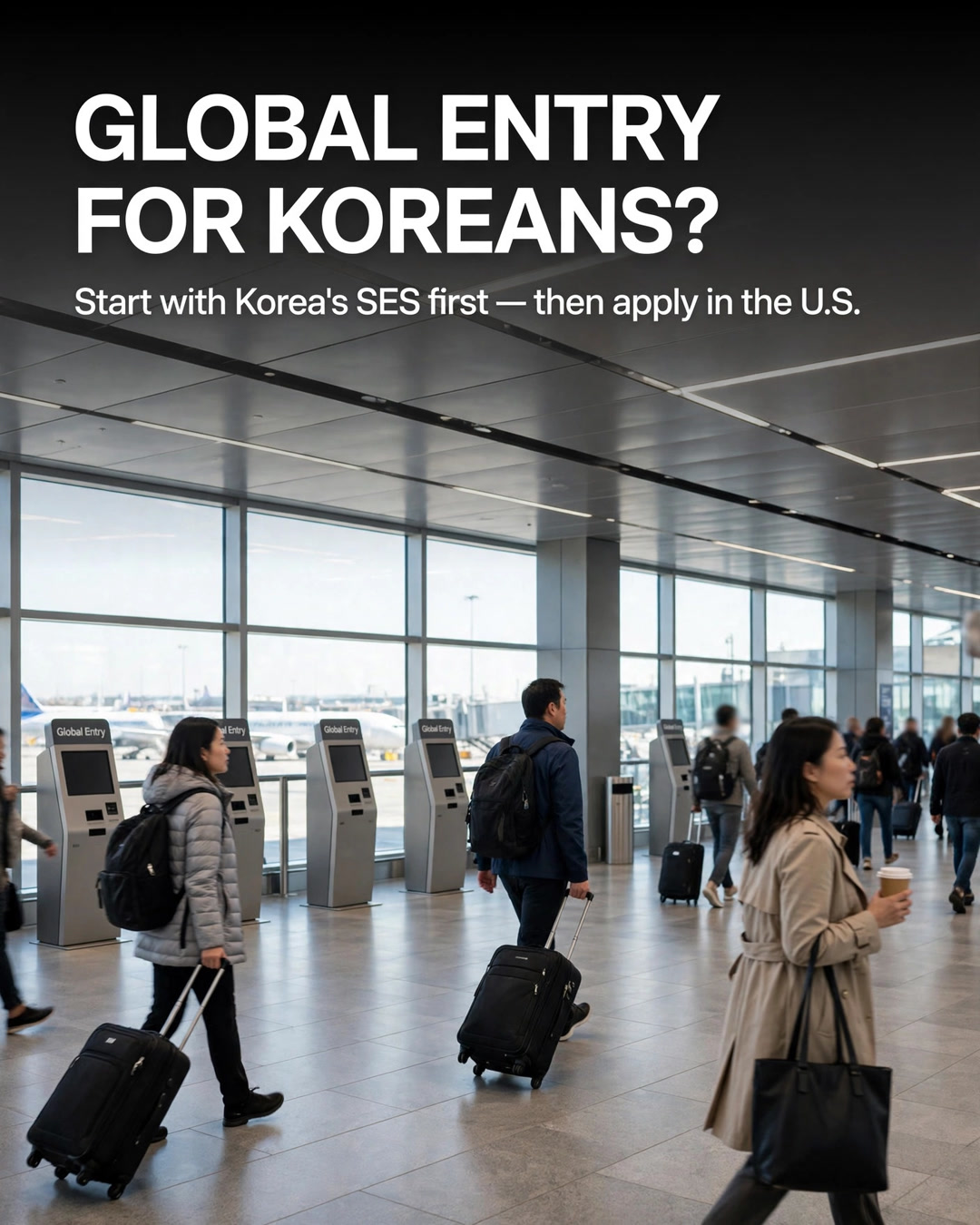
The fastest way through U.S. immigration is not a shorter line — it is skipping the regular line altogether. Global Entry, run by U.S. Customs and Border Protection (CBP), gives pre-approved, low-risk travelers expedited processing when they arrive in the United States, and membership also makes travelers eligible for TSA PreCheck on domestic flights. For frequent Korea–U.S. travelers, that combination is the main attraction.
But Korean citizens cannot simply copy the U.S. application route. CBP states plainly that citizens of the Republic of Korea are eligible for Global Entry, and that they must first become members of Korea's Smart Entry Service (SES) — the Korean trusted-traveler program run with the Korea Immigration Service — and may then apply for Global Entry. Skipping the SES step is the mistake most likely to stall an application before it starts.
The cost is the same once the route is followed: a $120 non-refundable application fee for five years of membership, a background check, conditional approval, and an in-person interview — which can also be completed on arrival in the United States. This is how the Korean route works, what membership actually buys, and when to start so the benefit is ready before a trip, not after it.
Information checked: October 29, 2026.
What Is Global Entry?
Global Entry is a CBP trusted-traveler program for pre-approved, low-risk travelers entering the United States. Members use expedited processing at participating U.S. airports instead of the regular immigration line, and, as an added benefit, Global Entry members are eligible for TSA PreCheck expedited screening on eligible domestic flights. CBP notes that members may still be selected for further examination on any given arrival — membership speeds processing, it does not remove inspection.
It is an arrivals program, not a visa. It does not change whether a traveler needs a visa or an approved ESTA to enter the United States, and it does not replace a passport. Korean Global Entry members must still hold a valid passport and a visa or an approved ESTA to use the Global Entry processing technology to enter the United States, according to CBP's Korea page.
Who Can Apply — and Why Do Korean Citizens Start With SES?
U.S. citizens, U.S. nationals, and U.S. lawful permanent residents may apply, as may citizens of countries with which CBP has a trusted-traveler arrangement — including the Republic of Korea. For Korean citizens, the arrangement runs through SES: Korea's program for expedited processing at designated airports in Korea via e-gates, linked to Global Entry through a CBP partnership with the Korea Immigration Service.
The practical consequence is a two-step application. First, apply online and complete all requirements to become an SES member, through the SES portal. Then, once the application information has been submitted there, create an account on the U.S. Trusted Traveler Programs (TTP) website and pay the application fee. CBP's Korea page directs Korean applicants to the SES website first; starting on the U.S. site alone misses the required first step.
Approval is not automatic. CBP conducts a background check after the application and fee are submitted, and applicants are notified through their TTP dashboard whether the application is pending, conditionally approved, or denied. Travelers should keep the information in their TTP account current: CBP warns that incomplete or incorrect passport information can cause the processing technology to miscalculate digital I-94 data and can affect TSA PreCheck benefits.
What Does It Cost and How Long Does It Last?
The application fee is $120, non-refundable, for five years of membership. CBP's 2026 enrollment-event releases state the $120 fee and note one exception: applicants under 18 do not pay it if a parent or legal guardian is already a member of a Trusted Traveler Program or is applying at the same time. The fee is paid with the application, whether or not the application is ultimately approved, so it should be treated as the cost of applying, not the price of membership.
Membership is valid for five years. Renewals may be submitted up to 364 days before the membership expiration date, through the TTP website, and CBP sends a reminder to the email address on file before expiration. If a renewal application is submitted before membership expires, CBP allows benefits to continue for up to 24 months after the expiration date while the renewal is processed. Renewing early is therefore the way to avoid a gap; renewing after expiry does not carry the same protection.
How Do You Apply, Step by Step?
The Korean route, as CBP lays it out, runs in this order:
1. Become an SES member. Apply online through Korea's Smart Entry Service portal and complete all of its requirements.
2. Create a TTP account and pay. Once the SES application information is submitted, create an account on the Trusted Traveler Programs website (ttp.dhs.gov) and pay the non-refundable $120 application processing fee.
3. Wait for vetting. CBP conducts a background check; the application status — pending, conditionally approved, or denied — appears in the TTP dashboard.
4. Complete the interview. If conditionally approved, schedule an interview at a Global Entry Enrollment Center, or use Enrollment on Arrival: complete the interview when entering the United States from abroad at a participating airport, with no separate appointment required for that option.
5. Bring the right documents. At the interview, bring a passport and a photo ID showing the correct residence address. A CBP officer asks questions and collects biometric information (fingerprints, if applicable, and a photo). If approved, benefits begin immediately.
CBP does not publish a fixed processing time on the pages checked for this article, and interview availability varies by location — so the honest planning rule is to apply well before the trip the membership is meant to serve, rather than counting on it for an imminent departure.
What Do You Get at the Airport?
On arrival in the United States, members use Global Entry processing instead of the regular CBP inspection line at participating airports. For domestic travel, members are eligible for TSA PreCheck: CBP's Korea page states that no Global Entry card is needed for the PreCheck benefit — instead, the traveler enters the Global Entry membership number in the airline reservation to receive it. Travelers should add that number to each booking; without it, the PreCheck marking may not appear on the boarding pass.
Two limits matter. First, Global Entry does not exempt anyone from screening: members can still be selected for further examination. Second, membership details must stay current. If a member obtains a new passport, the information should be updated in the TTP dashboard; if a member obtains a new visa or changes their name, CBP requires notification in person at a Global Entry Enrollment Center, with no appointment necessary for those updates. Out-of-date account information can disrupt both entry processing and PreCheck.
Is It Worth It — and When Should You Start?
For travelers who fly between Korea and the United States more than occasionally, the value is straightforward: shorter arrival processing on every U.S. entry, plus TSA PreCheck on domestic U.S. flights, for $120 over five years. For travelers who fly internationally rarely, or only domestically within the United States, TSA PreCheck alone may be the cheaper fit — Global Entry's main benefit is at the U.S. border on arrival.
Timing is the deciding factor. Because the route runs through SES first, then U.S. vetting and an interview, it is a plan-ahead application, not a last-minute fix for a trip next week. Start with the SES portal, keep the TTP account and passport details current, and complete the interview — at an enrollment center or on arrival — before counting on the benefit. Applied for in that order, Global Entry turns the longest part of a Korea–U.S. trip, the arrival queue, into the shortest.
Official Sources
U.S. Customs and Border Protection — Global Entry for Korean Citizens
U.S. Customs and Border Protection — CBP to Host Global Entry Enrollment Event During 2026 IPW Conference (May 14, 2026)
U.S. Customs and Border Protection — CBP and Myrtle Beach International Airport to host Global Entry enrollment event (January 21, 2026)
This article reflects CBP Global Entry rules available on October 29, 2026. Fees, eligibility, and procedures can change — confirm the current rules on the official CBP and SES websites before applying. The 24-month renewal grace period is CBP policy as stated in CBP's renewal guidance quoted in coverage of the program; the SES-first requirement, $120 fee, five-year validity, and 364-day renewal window are stated on the CBP pages above.