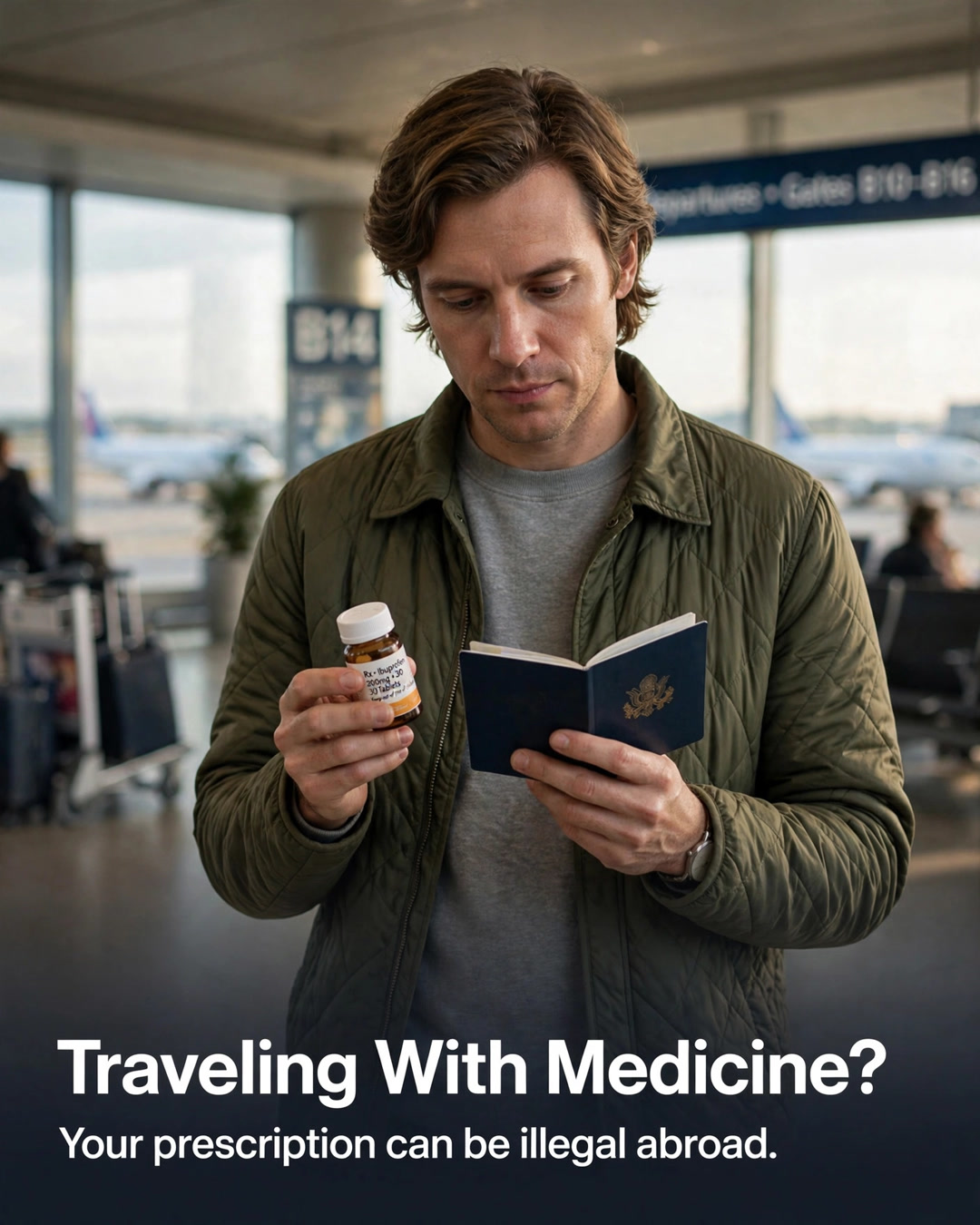
A prescription that is perfectly ordinary at home can be a problem at a foreign border. Medicines are regulated country by country, and a drug that is sold over the counter in one place can be a controlled substance in another — even when you hold a valid prescription from your own doctor. Travelers are stopped, have medicines confiscated, and in the strictest cases face arrest, not because they were smuggling anything, but because they packed a familiar bottle without checking the destination's rules.
The United States is relatively permissive at the security checkpoint. The Transportation Security Administration (TSA) allows prescription and over-the-counter medicines in pill, liquid, gel, and cream form, and medically necessary liquids are exempt from the usual 3.4-ounce limit. But TSA screening is only the first border. Customs and drug laws at the destination — and at any country where you change planes and leave the airport — decide whether your medicine can legally enter, and some of the strictest rules in the world apply in popular destinations such as Japan, the United Arab Emirates, and Singapore.
The safe pattern is the same everywhere: keep medicines in their original labeled containers, carry the prescription and a doctor's letter, bring only what you need for the trip plus a small margin, and check each country's rules before you leave — including every layover where you will pass through customs.
This is what TSA allows, why the original bottle matters, how liquid medicines and syringes are handled, and which medicines Japan, the UAE, and Singapore restrict or ban.
Information checked: October 28, 2026.
What Does TSA Allow at U.S. Airport Security?
The TSA allows all medications through the security checkpoint — prescription drugs, over-the-counter medicines, vitamins, and supplements, in pill, liquid, gel, cream, and aerosol form. Medication can go in carry-on or checked baggage, but the TSA strongly recommends carry-on, in case checked bags are delayed or lost and you need immediate access.
Pills and solid medicines have no quantity limit at the checkpoint and do not need to be presented to the officer. Liquid medicines are different: medically necessary liquids, medications, and creams may exceed the standard 3.4-ounce (100 ml) limit in reasonable quantities for the trip, do not need to fit in the quart-size zip-top bag, and must be declared to the officer at the start of the screening process. They are subject to additional screening, which can include opening containers, and travelers may request a visual inspection instead of X-ray — but the request must be made before items go through the tunnel.
Syringes and needles are allowed when they accompany injectable medication, and ice packs and gel packs used to keep medicine cold are allowed, with additional screening if they are partially melted. If you use a medical device such as an insulin pump or continuous glucose monitor, tell the officer before screening begins.
Should Medicine Stay in Its Original Container?
For TSA screening alone, no: the TSA does not require passengers to pack medicine in prescription bottles, and pill organizers are allowed at the checkpoint. But that is only half the story. Individual U.S. states have their own laws on prescription labeling, and — more importantly — customs officers abroad are not bound by TSA practice at all.
For international travel, the consistent advice from the CDC and travel-health sources is to keep medicines in their original, labeled pharmacy containers, with the label showing your name, the drug name and dosage, and the prescriber. The labeled bottle is the fastest way to prove the medicine is yours and prescribed to you. A pill organizer is convenient for daily use, but keep the original bottles in your bag as well, or at minimum carry a copy of each prescription and a list of the generic names — brand names differ from country to country, and the generic name is what foreign officials and pharmacists recognize.
For controlled substances and injectable medicines, go further: ask your doctor for a short letter stating what you take, the generic name and dose, and why you need it, and carry the prescription itself. That letter is what permit applications and customs officers ask for, and it is much harder to obtain from abroad than from home.
What About Liquid Medicine and Syringes?
Liquid medicines are the most common surprise at the checkpoint, because travelers assume the 3-1-1 liquids rule applies to everything. It does not apply the same way to medically necessary liquids: TSA permits them in quantities greater than 3.4 ounces in carry-on baggage, outside the quart-size bag. The conditions are simple — declare them at the beginning of the screening process and be ready for separate screening.
Pack liquid medicines where you can reach them, apart from your regular toiletries, so you can hand them over the moment you declare them. Keep them in their original labeled containers, and bring the prescription or doctor's note if the medicine is a controlled substance. The same approach covers inhalers, eye drops, and liquid-filled capsules, which count as medically necessary liquids.
For syringes, keep them with the injectable medicine they belong to, declare them, and bring a small sharps container or a plan for disposal — most aircraft lavatories have one. Refrigerated medicines such as insulin can travel with ice packs or insulated coolers in carry-on baggage; if a pack is partially melted or slushy at the checkpoint, it is screened like a medically necessary liquid.
Why Can a Legal Prescription Be Illegal Abroad?
Because drug laws are national, and a foreign prescription is not a defense everywhere. Each country sets its own list of controlled and prohibited substances, and those lists do not match. A stimulant prescribed for ADHD, a codeine cough syrup, a sleep aid, or a decongestant that is routine in the United States can be a controlled narcotic — or an outright banned substance — in Japan, the UAE, Singapore, South Korea, or parts of Europe.
The consequences are real and vary by country: confiscation of the medicine, travel delays, denial of entry, fines, and in the strictest cases arrest and imprisonment. The risk attaches to the substance, not to the dose or the intent — two tablets for a long-haul flight are subject to the same rules as a month's supply, and "my doctor prescribed it" does not override a ban.
The check must cover every country on the itinerary, including layovers. If you leave the airport during a connection — for a hotel stay, for example — you pass through that country's customs and its medicine rules apply, even if the country was never your destination. Passengers who stay airside in transit are usually exempt from import-permit requirements, but prohibited substances remain restricted even in transit in some countries, so check the transit country's rules too.
Which Medicines Does Japan Restrict or Ban?
Japan is the strictest major destination for travelers carrying medicine, and the one where ordinary prescriptions most often cause trouble. Its Ministry of Health, Labour and Welfare (MHLW) sets the rules, and the key points are:
Amphetamine-based stimulants such as Adderall and Dexedrine are prohibited outright under the Stimulants Control Act — even with a valid foreign prescription, and no import permit can make them legal. Travelers who take them should talk to their doctor before the trip about permitted alternatives.
Decongestants containing pseudoephedrine, such as Sudafed, and Vicks inhalers are banned or tightly restricted. Leave them home and check the MHLW list before packing any cold or sinus medicine.
Codeine and other narcotic and psychotropic medicines — including opioids, some sleep aids, and anti-anxiety medicines — require advance permission. For prescribed narcotics and stimulants' raw materials such as lisdexamfetamine (Vyvanse), travelers must apply to the Japanese government (the Narcotics Control Department or a Regional Bureau of Health and Welfare) and receive permission before leaving home.
For ordinary prescription medicines, Japan allows up to a one-month supply without an Import Confirmation certificate, and up to a two-month supply of over-the-counter medicines. Above those amounts, or for syringes and injectable medicines beyond a one-month supply, travelers must apply online for an Import Confirmation (Yunyu Kakunin-sho, formerly Yakkan Shoumei) and receive it before departure — processing can take up to three weeks.
Apply early, and carry the certificate, the prescription, and the original packaging. Japan's rules are published in English on the MHLW website, and the Japanese embassy recommends applying at least two weeks before departure.
What About the UAE, Singapore — and Your Layover?
The United Arab Emirates controls a long list of medicines, including codeine, tramadol, sleep aids such as zolpidem (Ambien), and anti-anxiety medicines such as diazepam (Valium) and alprazolam (Xanax). Visitors may bring controlled medicines for personal use — up to three months' supply — with a prescription and a medical report, and should obtain pre-approval through the health authority's online portal before traveling. Without the right paperwork, controlled medicines can be confiscated, and carrying them without approval can carry severe penalties. Passengers who remain in the airport transit area do not need approval, but anyone leaving the airport must comply with entry requirements.
Singapore's Health Sciences Authority (HSA) permits up to three months' supply of most medicines without advance approval, but certain controlled substances — strong painkillers, sleeping pills, and anti-anxiety medicines — require an application at least two weeks before arrival, with supporting medical documentation. Cannabis-derived products, including CBD oil, are prohibited even in transit.
South Korea and Thailand also restrict amphetamine-based ADHD medicines, and several European countries, including Greece, classify codeine as an illegal narcotic without a proper prescription. The pattern is the same in every case: the destination's list governs, the paperwork takes weeks, and the time to check is before booking, not before boarding.
Before you travel, run through this checklist:
List every medicine you take, by generic name and dose, including over-the-counter cold, allergy, sleep, and pain medicines.
Check each country's rules with its embassy, consulate, or health authority — including every layover where you will leave the airport.
Apply for any import permit or pre-approval at least two to four weeks before departure.
Keep medicines in their original labeled containers, in your carry-on, with the prescription and a doctor's letter.
Declare liquid medicines at security, and declare medicines at customs when asked — never hide them.
Bring enough for the trip plus a few extra days, and keep a digital copy of every prescription on your phone.
A prescription is not a passport for your medicine. The bottle that is unremarkable at home can be contraband abroad — and the check that prevents the problem takes minutes, weeks before you fly.
Official Sources
TSA — Travel Tips
https://www.tsa.gov/travel/travel-tips
Japan Ministry of Health, Labour and Welfare — Information for those who are bringing medicines for personal use into Japan
https://www.mhlw.go.jp/english/policy/health-medical/pharmaceuticals/01.html
Travel Guard — How to Pack Medication for Airport Security
https://www.travelguard.com/travel-resources/travel-tips/how-to-pack-medication-for-airport-security
Travel Noire — Your Medication Could Be Restricted Abroad. Check Before You Pack
https://travelnoire.com/travel-medication-restrictions
This article reflects TSA, Japanese, UAE, and Singapore medicine rules available on October 28, 2026. Controlled-substance lists, permit requirements, and quantity limits vary by country and medicine and can change — confirm the current rules with the destination country's embassy or health authority before you travel.