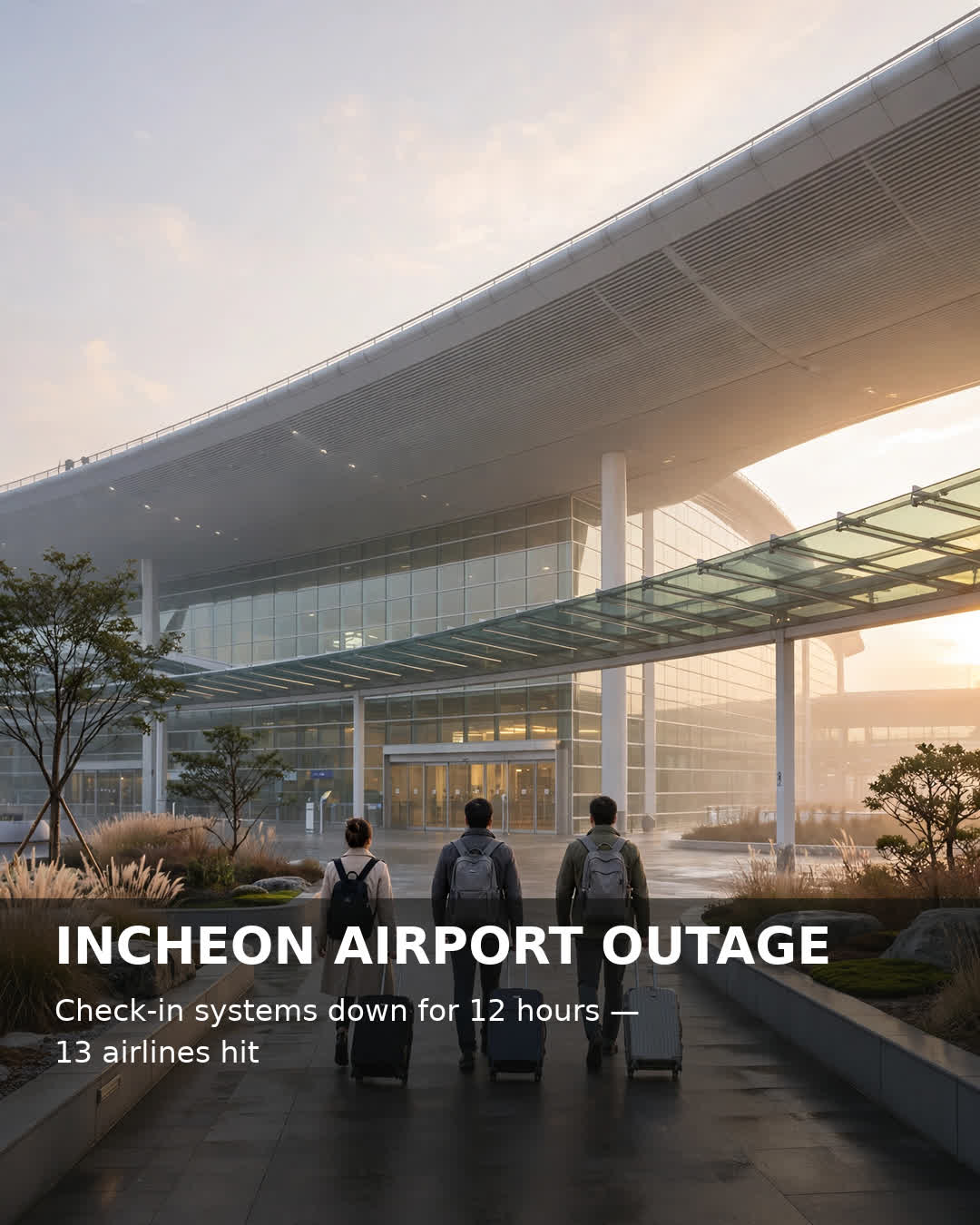
On Friday morning, October 30, 2026, travelers at Incheon International Airport — South Korea's main international gateway — found they could not check in normally. A fault in the airline network that connects ticketing and check-in systems left counters unable to process passengers electronically, and queues built up in both terminals.
The disruption affected 13 airlines: eight in Terminal 1 and five in Terminal 2. At the peak, about 1,200 travelers were waiting at the airport. Three Chinese carriers were hit hardest in the afternoon, when their ticketing system stopped working and staff had to check passengers in by hand.
The airport operator says the systems were restored around 5 p.m. Korea time, about 12 hours after the fault began — but the queues and knock-on delays did not clear instantly. By 7:30 p.m., about 100 people were still waiting while staff worked through the backlog.
This is what happened at Incheon on October 30, which airlines and terminals were affected, what is known about the cause, and what to check before flying through the airport in the coming days.
Information checked: October 30, 2026.
What Happened at Incheon Airport on October 30, 2026?
The fault began at about 4:30 a.m. Korea time in the airline network that links ticketing systems at Incheon International Airport. The network is used by airlines to exchange ticketing and check-in information, so when it faltered, check-in counters could not reliably complete the normal path to a boarding pass. Passengers could reach the airport, but the electronic workflow behind the counter was not working.
The airport was not shut down, and the outage was not airport-wide in the sense of a total blackout: it centered on the systems airlines use for ticketing and check-in. Staff switched parts of the workflow to manual processing for some passengers whose flights were approaching departure, but that could not replace the normal electronic process at scale, and queues grew through the day.
By the afternoon, the ticketing systems used by China Southern Airlines, China Eastern Airlines and Air China had stopped working, and those three airlines were effectively unable to issue tickets normally. Check-in lines formed in front of their counters in Terminal 1, and staff processed only some passengers by hand.
Which Airlines and Terminals Were Affected?
Thirteen airlines were affected in total: eight in Terminal 1 and five in Terminal 2, according to Incheon International Airport Corp. The airport operator did not publish a full list of the 13 airlines in the reporting available on October 30, so travelers should check with their own airline rather than assume they were or were not affected.
The three airlines hit hardest were China Southern Airlines, China Eastern Airlines and Air China. By the afternoon their shared ticketing system, TravelSky, had stopped working, so normal ticketing at those three carriers was halted and staff handled passengers manually on a limited basis. The airport later said all three had resumed ticketing operations.
The disruption was concentrated on the airline-side systems, not on the airport's own facilities: security screening and the terminals themselves kept operating, and the problem was getting passengers through check-in and ticketing, not moving them through the building.
How Long Did the Outage Last?
The fault began at about 4:30 a.m. and the airport said the systems resumed normal operation at about 5 p.m. Korea time — roughly 12 hours later. The airport operator confirmed that check-in was operating normally again after the restoration.
Recovery did not mean instant normal service. The queues and flight delays built up during the day took time to clear: by 7:30 p.m., about 100 people were still waiting at the airport, although the number had fallen sharply from the peak of about 1,200. Residual check-in demand and knock-on flight effects continued into the evening even after the underlying systems were back.
How Many Flights Were Delayed?
Dozens of flights were delayed. Outlets reporting through the day gave different totals, because they were counting at different times and by different methods: SBS reported 35 delayed flights, Newspim reported 38, and Newsis later reported 58. No single number should be treated as the final total without a consolidated update from the airport operator, so the safest description is that dozens of flights were delayed.
At the peak of the disruption, about 1,200 travelers were waiting at the airport. Yonhap reported that as of 5 p.m., 38 flights had been delayed, leaving some 1,200 travelers stranded. No cancellations were confirmed in the reporting available on October 30 — that is an absence of reporting, not a confirmed zero, and travelers should check their own flight status.
What Caused the Outage?
The cause was still under investigation on October 30, and no confirmed root cause had been announced. The airport operator said the disruption appeared to have been caused by instability in the global network of ARINC (Airlink), the U.S. aviation communications provider whose network airlines use — but that was presented as the operator's assessment, not a confirmed finding.
Newsis reported that the airport was examining network instability involving both ARINC and TravelSky, the ticketing system used by some carriers — the two problems overlapped during the day, with the ARINC network fault first and the TravelSky fault affecting the three Chinese carriers in the afternoon.
SBS reported that the airport initially viewed a network problem as more likely than hacking, because only certain airlines were affected. The possibility of hacking had not been fully ruled out. For that reason it is too early to describe the incident as a cyberattack or to blame a specific supplier.
What Should Travelers Do Before Flying Through Incheon?
Check your flight status with your airline before leaving for the airport. The systems were restored on the evening of October 30, but knock-on delays can linger into the next day as aircraft and crews fall out of position, so a flight that looks fine on the departure board may still be running late.
Allow extra time at the airport. A system outage turns a routine check-in into a queue, and manual processing — the fallback when the electronic systems fail — moves far fewer passengers per hour than the normal workflow. Keep your booking reference and passport ready, and if you are flying with one of the airlines that was affected, confirm with the airline that your check-in is proceeding normally.
If a check-in system fails while you are at the airport, follow the airline staff's instructions at the counter rather than joining a different queue: during the October 30 outage, staff processed passengers with imminent departures by hand on a limited basis, and priority went to those closest to departure.
Official Sources
Korea JoongAng Daily — Incheon airport check-in system restored after ARINC outage delays 38 flights
Yonhap (via Korean Vibe) — (LEAD) Check-in system at Incheon airport restored after hourslong disruption
https://korean-vibe.com/article/179572044291689
Aju Press — Incheon Airport Network Outage Disrupts Ticketing for 13 Airlines
https://www.ajupress.com/view/20261030144070739
Status Is Down — Incheon Airport restores check-in systems after network outage disrupts 13 airlines
https://statusisdown.com/en/articles/incheon-airport-checkin-network-outage-october-2026
Flight status can change quickly after a system outage — check with your airline before you leave for the airport, and confirm the current situation at Incheon before traveling.