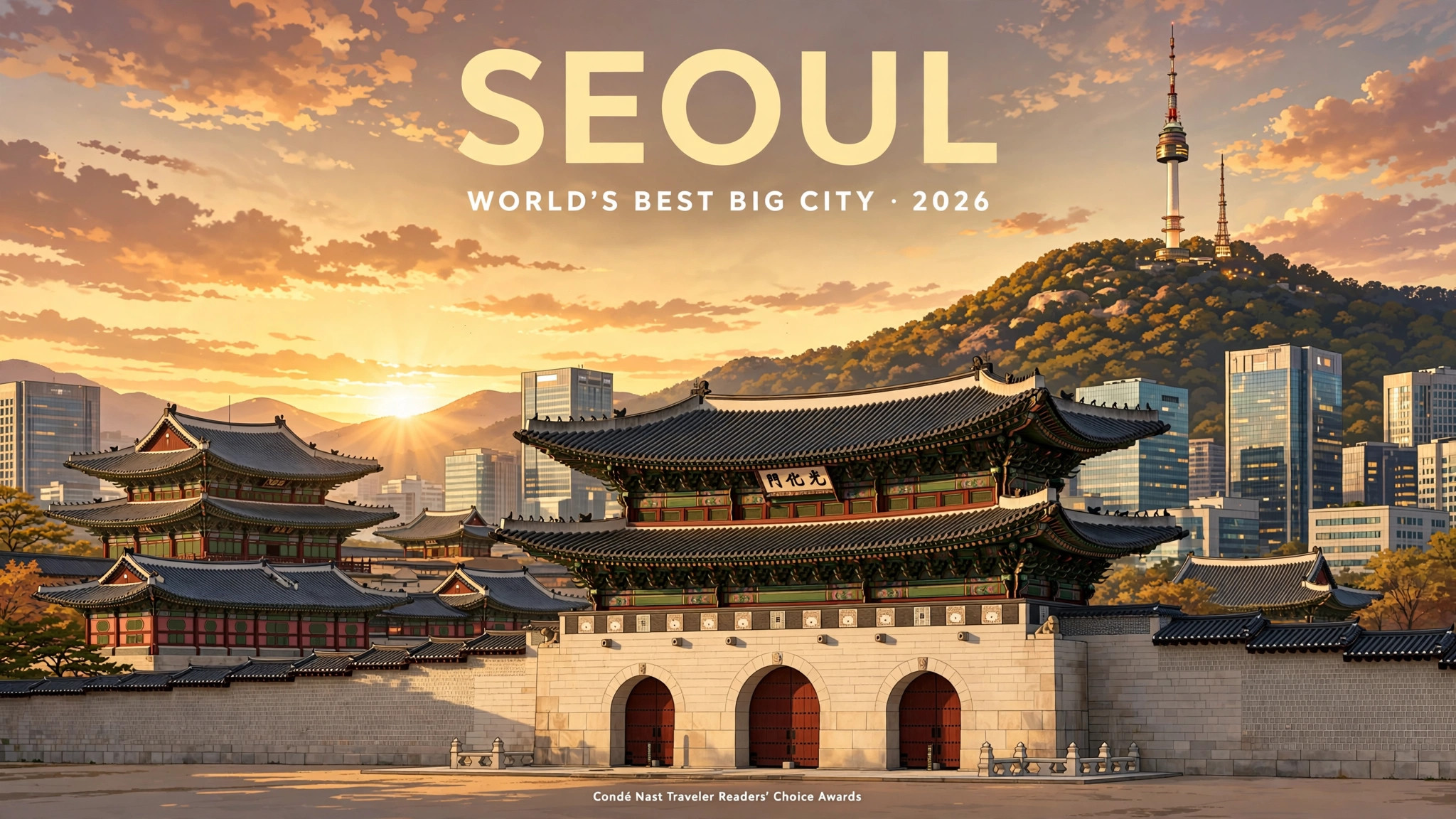
Seoul is officially the world's best big city. In Condé Nast Traveler's 2026 Readers' Choice Awards, announced on October 6, 2026, readers voted South Korea's capital No. 1 among large cities worldwide — the first time Seoul has topped the list.
Seoul climbed four places from No. 5 in 2025, overtaking Tokyo, which had held the top spot for two consecutive years and has won the category seven times. Tokyo finished second, followed by Phnom Penh, Shanghai, and Sydney. The 39th edition of the awards drew 798,867 votes across all categories, covering cities, hotels, resorts, and other travel experiences.
The result reflects the votes of the magazine's U.S. readers rather than every traveler worldwide, and it does not prove that any single attraction or trend caused the win. But it is a useful snapshot of how the city is seen right now — and the reasons readers gave point to the same mix the city is known for: K-pop, K-beauty, and K-dramas on the surface, and more than 2,000 years of history underneath.
If you are planning a first trip, four places capture that mix better than any others: Gyeongbokgung Palace, Gwanghwamun Gate, N Seoul Tower, and Insadong. This is what the ranking says, why Seoul won, and how to see the best of it.
Information checked: October 28, 2026.
What Did Readers Vote For?
The Best Big Cities category is part of the annual Readers' Choice Awards run by the U.S. edition of Condé Nast Traveler, decided entirely by reader votes. The 2026 edition was the 39th, with 798,867 votes cast across every category, from cities and hotels to resorts, airlines, and airports.
The 2026 top 10 large cities, in order, were: Seoul, Tokyo, Phnom Penh, Shanghai, Sydney, Montreal, Paris, Cape Town, Singapore, and Kyoto. Five of the top 10 are in Asia.
This is a readers' ranking, not an expert panel or a measurement of hotels, transport, or value for money. It changes every year — which is also what makes it a good prompt for a trip, rather than a verdict to argue with.
Why Did Seoul Win This Year?
"If there's a single destination that embraces dichotomy, it's Seoul," the magazine wrote in its entry on the city. The global popularity of K-pop, K-beauty, and K-dramas has helped make Seoul one of the world's most popular leisure destinations, the entry said, but "beneath these of-the-moment pleasures is a layered, complex history stretching more than 2,000 years." It called the city "a beguiling mix of historic and modern, natural and tech-savvy, and affordable and extravagant."
The magazine also highlighted beauty and wellness, art, and dining, and the chance to experience centuries-old sites and modern entertainment districts in a single trip — from affordable local experiences to luxury hotels, fine dining, and shopping.
The visitor numbers point the same way. According to the Seoul Metropolitan Government, 8.23 million international visitors came to Seoul in the first half of 2026, up 21.3% from the same period in 2025, and card spending by international visitors reached about ₩5.62 trillion (roughly US$4.2 billion), up 56.8% year over year. Those figures show that international tourism to Seoul is growing fast. They do not by themselves explain why readers voted the way they did — but they confirm the city is having a moment, not just a ranking.
Gyeongbokgung and Gwanghwamun: Where Does Old Seoul Meet the New?
Gyeongbokgung, built in 1395, is the largest and grandest of Seoul's Five Grand Palaces and was the main royal palace of the Joseon Dynasty. Its main gate, Gwanghwamun, faces south toward the modern city — the exact axis where the magazine's "dichotomy" line becomes visible: palace walls on one side, glass towers and Gwanghwamun Square on the other.
The Royal Guard Changing Ceremony is held in front of Gwanghwamun Gate, in colorful royal dress. The palace is closed on Tuesdays, so plan around that. Adult admission is 3,000 won, and wearing traditional hanbok grants free admission. The nearest station is Gyeongbokgung Station, Line 3, Exit 5.
Just outside the gate, Gwanghwamun Square holds the statues of King Sejong and Admiral Yi Sun-sin. The gate, the square, and the palace together make one walk — and the best first morning in Seoul.
What Can You See from N Seoul Tower?
N Seoul Tower stands on Namsan Mountain in central Seoul, and its observation deck gives a 360-degree panorama of the city, the surrounding mountains, and the Han River. It is the classic counterpoint to the palace: from up here, the old and new city read as one map.
You can reach it by cable car, by bus, or on foot up Namsan. The tower is also known for the "locks of love" fences, where couples leave padlocks.
Go before sunset if you can: arrive in daylight, watch the city light up, and see both versions in one visit. Check the observation deck's hours before you go, as they vary by season.
Why Is Insadong Still Seoul's Most Charming Street?
Insadong is Seoul's traditional-culture street: tea houses, craft shops, art galleries, antique shops, and workshops for calligraphy, paper, and ceramics, along the main street and its alleys — including the Ssamzigil courtyard complex.
It sits within walking distance of Gyeongbokgung and Bukchon Hanok Village, so it pairs naturally with a palace morning: palaces first, then tea. The tea houses are the rest stop — sit down, slow down, and treat the street as a browse rather than a checklist.
Insadong's shops tend to keep shorter hours than the late-night streets of Myeongdong, so an afternoon visit works better than a late one.
What Else Is New in Seoul Right Now?
The big-city ranking was not Seoul's only mention. In a separate list from the U.K. edition of Condé Nast Traveller, Seoul placed third among the world's friendliest cities for 2026, behind Melbourne and Porto. The magazine cited everyday kindnesses — restaurant owners explaining dishes, commuters helping visitors navigate the subway.
Time Out, meanwhile, named Jongno 3-ga the world's coolest neighborhood for 2026, citing its mix of traditional hanok areas, late-night street food, workshops, and independent shops. Jongno is the same district as the palace, the square, and Insadong — so the neighborhood the world is talking about is the one this trip already covers.
Planning a first trip? Start here:
Check opening days first — Gyeongbokgung is closed on Tuesdays.
Start at Gwanghwamun in the morning for the guard ceremony, then walk to Insadong for the afternoon.
Save N Seoul Tower for sunset.
Carry a card that works in Korea for admission and transport, and keep some cash for market stalls and small shops.
Confirm hours, admission, and event schedules before you go — they change by season.
The ranking is one vote, from one year, by one magazine's readers. But the four places above are where the city's "historic and modern" mix is easiest to feel in a single trip — and that is the part that will still be true long after the next ranking.
Official Sources
Korea JoongAng Daily — Seoul tops Tokyo as world's best big city, say U.S. Condé Nast readers
Aju Press — Seoul named world's best big city in Condé Nast Traveler
https://www.ajupress.com/view/20261008114842293
Welcome to Seoul — Seoul Metropolitan Government official tourism site
https://en.welcometo.seoul.kr/
This article reflects the ranking and visitor information available on October 28, 2026. Rankings are reader votes, not a measure of every traveler's experience — confirm opening hours, admission, and event schedules with the official sources before you travel.